
All of us deal with the effects of the problems in our children’s brains, and today I realized that although I understand basic anatomy, it’s time for me to get in there and learn more. So I am starting my own studies on development and anatomy. I wanted to share a bit of info from a book I’m reading:
The human brain is built out of billions of nerve cells, or neurons, each of which is shaped much like a tree. Thus, a mature neuron has an extensive root system, called the dendrites, taht receives input from other neurons, and a trunk, or axon, that can be extremely long and ultimately branches out to relay information to the next neurons in its circuit. In between these two branched systems lies an enlarged area, the cell body, which contains the nucleus and oversees the cell’s basic metabolic functions. Within each neuron, information is transmitted electrically by brief impuluses called action potentials; but when the impuluse arrives at the end of each axon branch, the information must cross a gap, the synapse, in order to be transmitted to the next neuron in the circuit. The gap is traversed by the release of a chemical messenger, or neurotransmitter, from the presynaptic terminal of the axon. Neurotransmitter molecules then diffuse the short distance across the synapse, where they bind to special receptors on the postsynaptic neuron’s dendrites, triggering electrical responses in each such receiving neuron. This same sequence of electrical and chemical transmission repeats itself through every cell and synapse of the circuit.
Source: What’s going on in there
I wanted to focus a bit on neurotransmitters. Here’s Wikipedia’s definition:
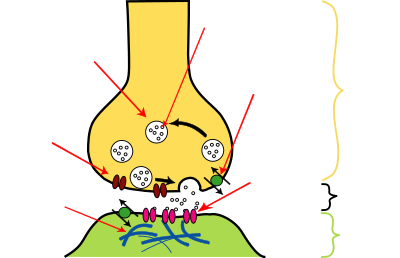
he only direct action of a neurotransmitter is to activate a receptor. Therefore, the effects of a neurotransmitter system depend on the connections of the neurons that use the transmitter, and the chemical properties of the receptors that the transmitter binds to.
Here are a few examples of important neurotransmitter actions:
* Glutamate is used at the great majority of fast excitatory synapses in the brain and spinal cord. It is also used at most synapses that are “modifiable”, i.e. capable of increasing or decreasing in strength. Modifiable synapses are thought to be the main memory-storage elements in the brain.
* GABA is used at the great majority of fast inhibitory synapses in virtually every part of the brain. Many sedative/tranquilizing drugs act by enhancing the effects of GABA. Correspondingly glycine is the inhibitory transmitter in the spinal cord.
* Acetylcholine is distinguished as the transmitter at the neuromuscular junction connecting motor nerves to muscles. The paralytic arrow-poison curare acts by blocking transmission at these synapses. Acetylcholine also operates in many regions of the brain, but using different types of receptors.
* Dopamine has a number of important functions in the brain. It plays a critical role in the reward system, but dysfunction of the dopamine system is also implicated in Parkinson’s disease and schizophrenia.
* Serotonin is a monoamine neurotransmitter. Most is produced by and found in the intestine (approximately 90%), and the remainder in central nervous system neurons. It functions to regulate appetite, sleep, memory and learning, temperature, mood, behaviour, muscle contraction, and function of the cardiovascular system and endocrine system. It is speculated to have a role in depression, as some depressed patients are seen to have lower concentrations of metabolites of serotonin in their cerebrospinal fluid and brain tissue.[3]
* Substance P undecapeptide responsible for transmission of pain from certain sensory neurons to the central nervous system.Neurons expressing certain types of neurotransmitters sometimes form distinct systems, where activation of the system affects large volumes of the brain, called volume transmission. Major neurotransmitter systems include the noradrenaline (norepinephrine) system, the dopamine system, the serotonin system and the cholinergic system.
Source: Wikipedia
So why am I talking about neurons and neurotransmitters? Because I wanted to point out that for therapies to work and be assimilated into the brain, neurotransmitters have to be present to carry the message and stimulate responses in other neurons. Without neurotransmitters, the capacity of the brain to respond and make connections is limited. And how do we make sure we are producing the right neurotransmitters? You guessed it – proper nutrition.