Getting Real

I’m going to quote from Amy’s blog:

Today, Melanie over at Better Than Normal posted “Everything Out On The Table”. She’s overwhelmed, depressed, and coming to the realization that she’s “not the super mom she wanted to be.”

Last week Katy over at Bird On The Street posted “Jealousy Jane”. Sharing the difficulties of seeing other families with multiple children, all healthy, and we don’t even have one healthy kid. She quickly followed up the next day with “Counting My Blessings” because she is not about being negative. Just real. Admitting the struggles we all face as the moms of special children.

Amy, Eli’s mom, also joined in by sharing about her own fears and experiences.

I figured I’d jump on this boat too.

* I feel a murderous rage when I think of how Nathan’s neurosurgeon injured him further. If I ran into that guy today I think I would physically hurt him. The child already had a lot to deal with – why did that @sshole piece of $hit have to hurt him even further?

* Nowadays I live day by day and don’t allow my mind to think of the future. Day at a time. But when it goes there and I can’t stop it – days when I’m tired, days when I’m stressed – it scares the crap out of me. Sure he’s a lot of fun now, when we can carry him and toss him around and chug him along with us wherever we go – but what will life be like when he is 80 pounds?

* I suffered sooo much when Nathan was little. I simply couldn’t accept his disability. I was determined to fix him. Realizing that I simply couldn’t fix him shattered me to pieces, and I’ve spent the last couple of years trying to rebuild myself. Today I feel much stronger, but it was sure a hard, heartbreaking, lonesome journey.

* Sometimes I 2nd guess myself. I posted a couple of days ago about my view on rehabilitation. There are days, however, when I wonder – am I holding Nathan back by not picking one thing and sticking to it? I try to be strong and believe in my choices but sometimes I wonder…and that wondering is so painful because then I feel responsible for his lack of progress and development.

* My extremism towards Nathan’s rehabilitation has put such a strain on my relationship with Owen. It has been so difficult for us at times – making tough decisions, especially as we have such opposite views about Nathan’s care, has almost torn us apart. We have managed to become stronger through it all but it has been a STRUGGLE. There were times where I just didn’t see how we could pull through. It’s not just the big decisions, it’s the little day to day things. Fortunately our love of each other is so huge that we’ve survived, but I could write a book about all we have gone through and managed to overcome.

* I have gone through moments where I just want to shake Nathan and tell him to just get over it! For example, his aversion to being put on the floor on his back or belly drives me crazy! The moment his butt hits a surface, he goes into instant whiny mode. I know this is holding him back and I just want him to get over it! Those moments I forget just how hard every movement is for him and I just can’t understand why even turning from his back to his side is so hard – it seems so simple! I know it’s not, but it sure gets me frustrated sometimes.

* I’ve been in counseling since before Nathan’s birth. Without my counselor and support team – My mom, Owen, Miranda, Dr. Kenny, my chiropractor, and occasional massages – I don’t know if I could’ve made it through this journey. Literally. There were times were the only choice seemed to be to jump in my car and drive far far away. But with their support, I managed to stay put. Thank God.

Real enough?
Hbot take 3

Owen and Nathan are on their way to Irvine right now for Hbot take 3. I finally accepted that I’m, well, too pregnant to keep running around. So Owen was wonderful in being wiling to step in and completing this treatment with Nathan. He took his whole office with him and is planning on working from within the chamber and when Nathan is having suit therapy.

They’ve only been gone a little while and I already miss them terribly! But I have big plans for this week – NESTING!

Belle’s nursery has been pinkified, her furniture is in, the living room has been painted, most of the furniture is on it’s way, the garage has been completely reorganized and we even dumped a whole uhaul truckload of stuff at Goodwill. This week I plan on finishing everything else! So it’s not really a rest time but at least I’ll get to focus on just one thing. Hope everyone had a great weekend!

Marcela’s Views on Rehabilitation

People often ask me why I do so many things with Nathan instead of sticking to one and committing to it.

The answer is simple: I do not believe that any ONE therapy can address ALL of Nathan’s needs. Nathan’s cerebral palsy affects him in every way therefore his needs are varied and multi-faceted.

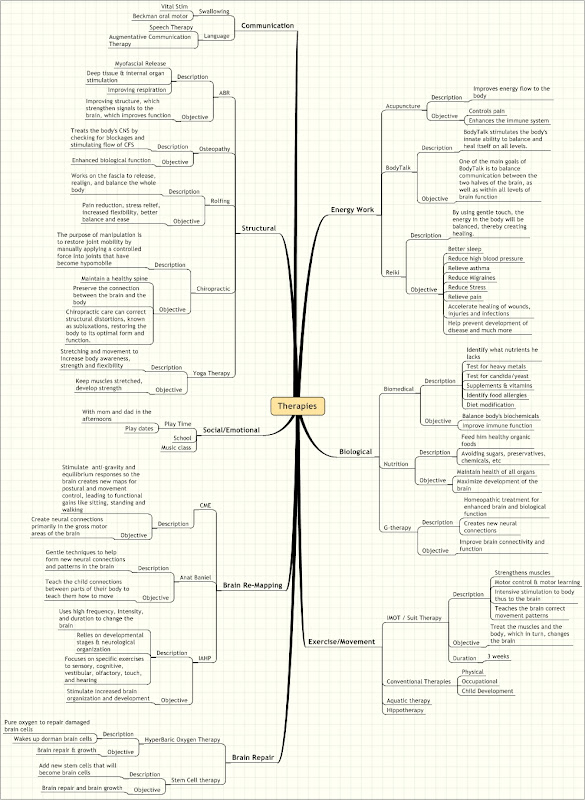
Below is a chart that I keep referring to and building on. You can’t read it here, but if you click on it and go to Picasa, and use their ZOOM function (top right with a + sign and magnifying glass), you will be able to see the picture more clearly:

I believe brain rehabilitation for a child as profoundly impacted as Nathan includes the following categories:

– Brain Repair
– Brain remapping
– Biological
– Structure
– Energy Work
– Exercise / Movement
– Communication
– Social / Emotional

I’ll describe what role I believe each one of these categories plays in the “big picture”:

Brain Repair

These are therapies that work on the brain itself without requiring participation. They work on a very subtle level by creating new brain cells, repairing damaged cells, and awakening dormant cells.

Therapies that belong to this category are: Hyperbaric Oxygen Therapy and Stem Cell Therapy. These are therapies that rehabilitate the actual cells of the brain. Stem cells create new brain cells and by having more cells available, improves the ability of the brain to communicate and function. HBOT improves oxygenation to the existing cells thus repairing damaged cells and awakening dormant cells.

Brain Re-mapping

The brain contains specific areas allocated for predetermined functions. For example, the occipital lobe handles vision. The basal ganglia coordinates movement, the cerebellum balance. Sometimes these areas are poorly developed. Therapies in these categories are meant to improve the definition and efficiency of brain mapping to improve bodily functions.

Therapies in these category include: Cuevas Medek Exercises, Anat Baniel Method, Institutes for the Achievement of Human Potential. These therapies give the body sensory input in order to improve the brains connectivity and efficiency in processing stimuli. These therapies improve dendriditic connections and density, thus leading to improved neural communication.

Biological

In order for the body, specifically the central nervous system, to work at optimum capacity it has to have proper nutrients and biochemicals, such as neurotransmitters. Sometimes, however, the body cannot produce specific biochemicals or is not communicating effectively due to improper nutrition or damage in the genetic code. This area addresses nutrition in order to maximize bodily function as a whole – not just the brain. For example, if the digestive system is impacted, the immune system suffers, thus affecting the central nervous system. So in this area I address the body as a whole by optimizing the quality of foods and supplements consumed.

Therapies in this category include: Biomedical, nutrition, and G-therapy. Biomedical includes identifying food allergies and other irritants, detoxification, and proper supplementation. Nutrition relates to proper diet with healthy organic, natural foods. G-therapy is a homeopathic treatment that stimulates neurotransmitters and acts as a nerve growth factor. Together these treatments help to ensure that the body and central nervous system has the proper nutrition, minerals, herbs, etc to function properly.

Structure

When there is a brain injury, the child doesn’t move the way a typical child would, and this affects how the structure of the body develops. This in turn affects messaging to and from the brain, which again results in functional loss. It also leads to lots of pain and problems if a child develops problems like scoliosis, hip dysplasia, etc. This section addresses the structure of the body, including proper alignment of the spine as well as proper alignment of every part of the body. With incorrect alignment comes loss of function, so therapies in this section seek to improve structure in order to maintain health and to improve function.

Therapies in this section include: ABR (Advanced Biomechanical Rehabilitation), Osteopathy, Rolfing, Chiropractic, and Yoga. Each of these provides feedback to the body in order to preserve and/or correct alignment of the body.

Energy Work

The body has an innate ability to heal itself, but if there is a breakdown in energy flow, problems follow. This section addresses the subtle body and seeks to preserve and maintain overall health by enhancing energy flow.

Therapies in this category include: reiki, acupuncture, and body talk.

Exercise / Movement

Typical children spend the vast majority of their days running, jumping, playing, moving, exercising. Children with even mild movement problems may have difficulty engaging in these activities. Especially in the early years, the brain requires movement and proprioception to form connections and to enhance its development. The body also requires movement to remain healthy. Therefore therapies in this category are meant to keep the body healthy and to stimulate the brain.

Therapies in this category include: Suit Therapy, physical and occupational therapy, aquatic therapy, and hippotherapy. Notice that I am including physical and occupational therapies in this category. I believe these are valuable therapies in that they provide exercise and feedback to the brain, and can be very effective especially with children with mild injuries. But I believe that children with severe injuries need more intense interventions that address the brain.

Communication

Obviously it is important to address the child’s ability to eat, swallow, talk, and communicate. These improves brain development plus their quality of life.

Therapies in this category include: Vital Stim, Beckman oral motor exercises, speech therapy and augmentative communication therapy.

Social/Emotional

A brain injured child is first and foremost a child and also needs time to play and socialize! I believe this is a key part of the mix. A happy child can overcome immense odds.

Summary

Even though there may seem to be overlap in some of these categories, each of these addresses different needs of a severely brain injured child. I believe it is important to address all of these.

In this list I have only included the therapies that I have found to be effective in their categories. More could be added but I have only chosen ones that make sense to me, that are theoretically sound, and that have had a positive impact on Nathan and/or on other children.

In some cases I do more than one therapy per category. I believe that it is all feedback for the brain and the more we stimulate the brain, the better. When possible I try to stick to one therapy per category or to select complimentary ones, but it all depends on life circumstances. For example, if I cannot do CME, I choose another therapy in that category. Other times I combine them and will choose one therapy per category every week or every two weeks. For example, week 1 he may have reiki, week 2 acupuncture, week 3, bodytalk, week 4 reiki, etc. I believe in this way we are stimulating the same systems in different ways and keeping the brain active and responding at a higher level.

I know many people choose to find 1 or 2 things that work and they stick to those 100% of the time. But me, well, I like to view Nathan’s rehabilitation as a holistic approach and believe that doing a little bit of everything will bring him the most benefit!

DISCLAIMER: I am simply talking about what I believe works for us, and for Nathan. Everyone has their own views and experiences and knows what work for their children! I just believe that sharing knowledge is helpful as it may spark ideas for others. I don’t think rehabilitation is a one-size fits all sort of thing – it’s just whatever works best for you, your child, your familiy! This is what I choose for mine!